
Fleet Safety & Maintenance
In material handling operations, forklift tires are the most frequently overlooked component of fleet maintenance yet they are the single point of contact between your machinery and the ground. Worn, damaged, or degraded tires not only reduce operational efficiency, but also poses serious safety risks, exposing organisations to regulatory liability, increasing total cost of ownership. This guide outlines seven signs that it’s time to replace your forklift tires and explains why acting early protects both your workforce and your tires/equipment.
The Business Case
Why Forklift Tire Condition Is a Strategic Priority
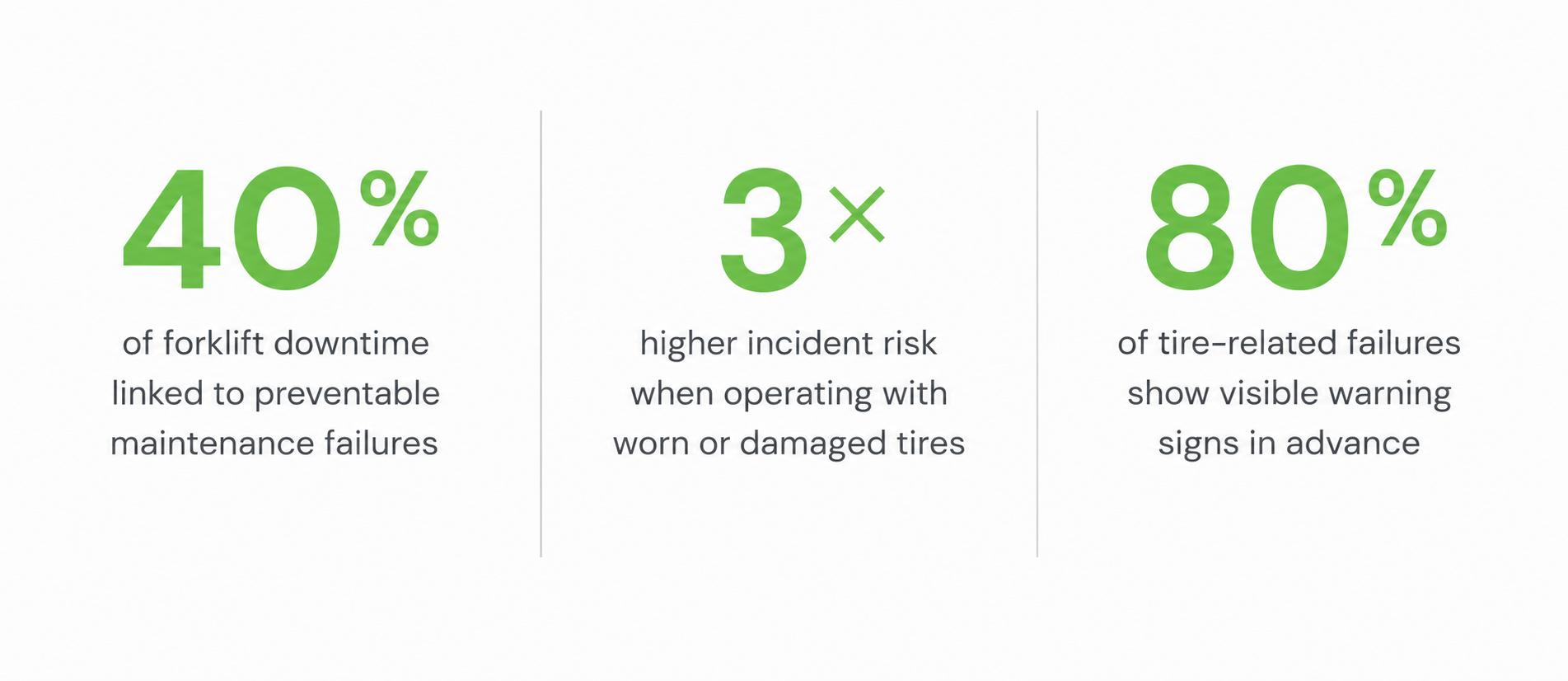
Forklifts are the workhorses at the heart of warehouses, ports and industrial operations. According to a 2023 study, failing to perform basic upkeep causes nearly 40% of unexpected forklift downtime, largely due to worn-out tires.
Replacing a set of forklift tires costs far less than a single workplace, productivity halt, or equipment repair demands. Proactive replacement is not a cost, it is an investment in continuous uptime and personnel safety
The 7 Warning Signs
Recognising the Signs — A Systematic Inspection Framework
The following seven indicators form a comprehensive pre-replacement checklist. Maintenance teams should incorporate these checks into routine daily walkarounds and scheduled service intervals.
1.Wear Below the Safety Line (Chunking & Flat-Spotting)
Most solid pneumatic and cushion forklift tires are manufactured with a moulded wear indicator commonly referred to as the “50% wear line” or safety band. When the tire tread has worn to or beyond this line, the structural integrity of the tire is compromised, grip diminishes significantly, and the tire is no longer rated for safe load-bearing operation. Chunking is the tearing away of large rubber segments is an advanced and urgent indicator that the tire must be removed from service immediately.
2. Visible Cracks, Tears, or Surface Deterioration
Rubber compounds are subject to oxidation, UV degradation, and chemical exposure particularly in environments with oils, solvents, or temperature extremes. Visible cracks along the sidewall or tread surface indicate that the rubber matrix is breaking down. Even surface-level cracking can propagate under load, leading to sudden blowout or delamination. Any tire exhibiting consistent cracking patterns should be flagged for immediate replacement.
3. Excessive Vibration During Operation
Operator-reported vibration during routine travel particularly at low speeds where vibration should be minimal is a reliable indicator of tire deformation, internal structural damage, or uneven wear profiles. Persistent vibration accelerates wear on mast components, hydraulic systems, and load-bearing frames, creating a cascade of secondary maintenance requirements. If operators consistently report a rough or uneven ride, tire inspection should be the first diagnostic step.
4. Tearing or Separation of the Tire from the Rim
The bond between a press-on solid tire and its metal rim is critical to safe operation. When this bond weakens evidenced by visible gaps, movement between the tire and rim, or rubber “walking” off the wheel the forklift’s stability and steering response are immediately compromised. This failure mode is particularly dangerous during loaded travel and turning manoeuvres, where lateral forces are highest. Separation at the rim constitutes a direct safety emergency.
5. Noticeably Reduced Load Stability
Forklift stability is a function of multiple variables, but tire condition is foundational. When tires are excessively worn, the effective wheelbase geometry changes subtly altering the vehicle’s stability triangle. Operators who report that loads feel less stable, that the forklift tips more readily, or that directional control has degraded should prompt an immediate inspection. This sign is frequently masked in low-speed environments but becomes acute during turns, ramp travel, or elevated load operations.
6. Uneven Wear Patterns Across the Axle
Asymmetric wear where one tire on an axle wears significantly faster than its counterpart signals underlying issues including improper inflation (on pneumatic tires), misaligned axles, overloading on one side, or irregular operating surfaces. While uneven wear is both a symptom and a sign, tires showing measurably different wear profiles across a single axle should be replaced as a pair to maintain balanced handling characteristics. Investigating the root cause will prevent premature wear on replacement tires.
7. Age-Related Hardening on Low-Usage Equipment
Tires on forklifts with low operational hours may appear visually intact while having undergone significant rubber hardening due to age and environmental exposure. Hardened rubber loses its shock-absorption and grip characteristics, increasing surface impact on floors, reducing traction on wet or uneven surfaces, and raising the risk of operator injury from transferred vibration. As a general guideline, solid forklift tires should be evaluated for replacement after five years regardless of apparent wear level.
Our Recommendation
Implement a structured tire inspection log as part of your forklift pre-shift checklist. Document wear measurements, surface condition, and operator feedback at each inspection. This creates an auditable maintenance trail that supports both regulatory compliance and insurance requirements and enables predictive replacement before safety thresholds are breached.
Conclusion
”The Cost of Inaction Is Always Greater Than the Cost of Prevention”
Forklift tires are not a consumable to be managed at the point of failure they are a safety-critical component that demands regular, systematic attention. The seven signs outlined in this article represent observable, actionable indicators that, when acted upon promptly, protect your workforce, preserve your equipment, maintain operational continuity, and reduce total fleet costs.
At Trident, we support operations of all scales with expert guidance on tire selection, inspection protocols, and replacement solutions. Our technical specialists are available to assess your current fleet condition and recommend a maintenance approach tailored to your specific operating environment.
No comment yet, add your voice below!